ADHD? Autism? Something else?
Find out where you stand in 10 minutes.
Free screening tests built on the clinical scales professionals use (ASRS, AQ, PHQ-9...). Answer honestly, get your score right away, then decide whether you want the full report.
 Claude
AI analysis
Claude
AI analysis
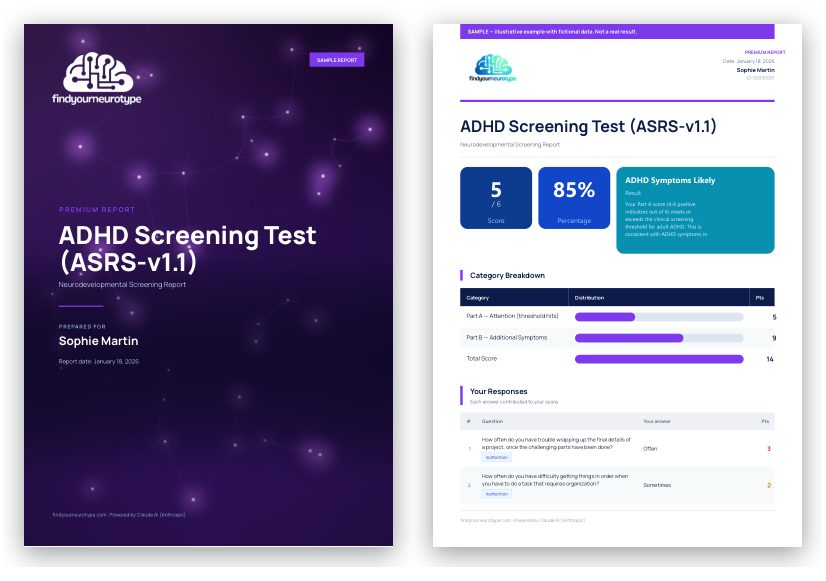 Cover + score page · fictional data · click to open the PDF
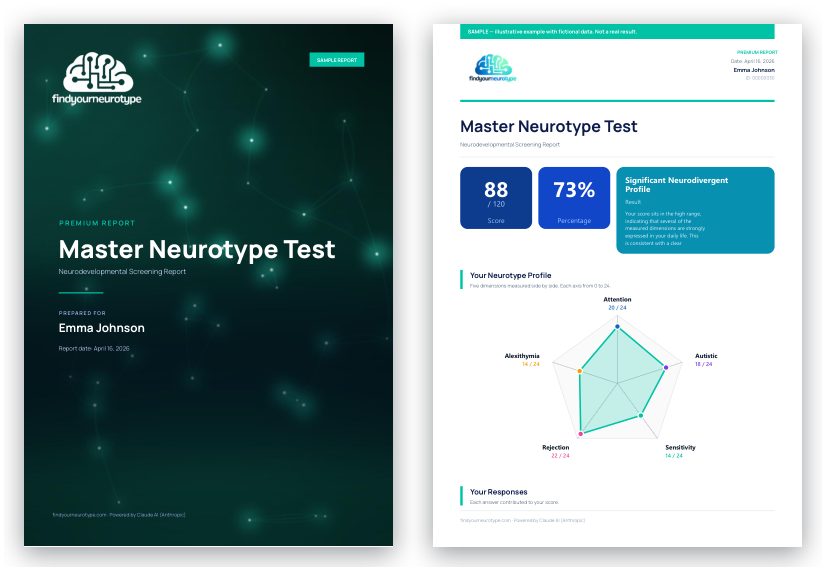 Your test, then your report
Here is what you get
The test is free and shows your score immediately. If you want to go further, the full report explains what your answers mean, area by area, and what to do next.
- ✓ Your score and where it sits on the clinical scale
- ✓ Breakdown by area: where it hurts, where it works
- ✓ A personalized analysis based on your own answers
- ✓ Concrete recommendations and what to bring to a professional
Choose Your Screening Test
Most tests are built on published clinical instruments; educational self-assessments are labelled as such. Take 8-25 minutes.
ADHD Screening Test (ASRS-v1.1)
Based on the Adult ADHD Self-Report Scale (ASRS-v1.1) developed by the World Health Organization. This 18-question screener evaluates symptoms of inattention, hyperactivity, and impulsivity in adults.
Autism-Spectrum Quotient (AQ-10)
The AQ-10 is a shortened version of the Autism-Spectrum Quotient (AQ) developed by Simon Baron-Cohen and colleagues at the University of Cambridge. It measures autistic traits in adults.
Cognitive Abilities Assessment
A non-verbal matrix-based cognitive assessment measuring logical reasoning, pattern recognition, and abstract thinking. Inspired by Raven's Progressive Matrices principles.
Sensory Profile (SPQ)
Adult Sensory Processing Questionnaire (Blanche, Parham & Chang). 49 questions across 11 sensory patterns. Each pattern has validated clinical thresholds (Typical / Possible Difficulties / Definite Difficulties).
OCD Screening (OCI-R)
The Obsessive Compulsive Inventory Revised (OCI-R) is a validated 18-item tool developed by Foa et al. (2002) to screen for Obsessive-Compulsive Disorder. It measures six symptom dimensions: washing, obsessing, hoarding, ordering, checking, and neutralizing.
Anxiety Screening (GAD-7)
The Generalized Anxiety Disorder 7-item scale (GAD-7) is the most widely used validated tool for detecting and measuring anxiety severity. Developed at Columbia University, it is trusted by clinicians worldwide.
Depression Screening (PHQ-9)
The Patient Health Questionnaire-9 (PHQ-9) is the gold-standard validated tool for screening, monitoring, and measuring the severity of depression.
Dyspraxia / DCD Screener
Developmental Coordination Disorder (DCD), also known as dyspraxia, affects motor coordination and planning. It is found in approximately 5-6% of school-age children and often persists into adulthood. This screener assesses coordination difficulties, motor planning, and their impact on daily life.
Dyscalculia Screener
Dyscalculia is a specific learning difficulty that affects the ability to understand, process, and work with numbers and mathematical concepts. It affects approximately 5-7% of the population and is often co-occurring with ADHD and dyslexia.
Highly Sensitive Person (HSP) Scale
The HSP Scale by Dr. Elaine Aron (1996) assesses Sensory Processing Sensitivity (SPS), a validated personality trait present in ~15-20% of the population. HSP is not a disorder but a neurological trait.
Visual IQ - Raven Matrices
20 pure visual matrix questions testing abstract and non-verbal reasoning.
Verbal IQ - Language & Reasoning
20 questions covering analogies, vocabulary, odd-one-out and verbal categories.
Numerical IQ - Math & Logic
20 questions on number sequences, arithmetic reasoning, proportions and patterns.
Spatial IQ - 3D & Mental Rotation
20 questions testing spatial visualization, mental rotation and geometric logic.
Autism Spectrum Quotient (AQ-50)
Full 50-question AQ. 5 domains: Social Skills (SS), Attention Switching (AS), Attention to Detail (AD), Communication (CO), Imagination (IM). Clinical threshold: 32/50.
Dyslexia Screener
Dyslexia is a specific learning difficulty affecting reading, writing, and spelling. It is one of the most common learning differences, affecting approximately 10% of the population, and is unrelated to intelligence. This screener assesses core dyslexia indicators in reading, phonology, and working memory.
Complete IQ Assessment
The most comprehensive cognitive test: verbal, numerical, visual and spatial reasoning combined. Age-normed IQ score with full cognitive profile.
Burnout Screening (OLBI)
Assess your level of professional exhaustion and disengagement using the Oldenburg Burnout Inventory - 16 validated items.
High Potential Screening (HPI/HQI)
Explore cognitive, emotional and sensory traits associated with high intellectual potential - 20 items.
Sleep Quality Test (PSQI/Epworth)
Assess your sleep quality, insomnia symptoms and daytime sleepiness using validated clinical scales - 14 questions.
Alexithymia Test (TAS-20)
Discover your ability to identify, describe and process emotions - 20 items from the Toronto Alexithymia Scale.
Procrastination Test (Lay GPS)
Measure your tendency to delay tasks using the General Procrastination Scale - 20 validated items.
ADHD Child Screening (Conners)
Parent-completed screening for ADHD symptoms in children aged 6-17, based on the Conners Rating Scale - 18 items.
Trauma & PTSD Screening (PCL-5)
Assess post-traumatic stress symptoms using the PTSD Checklist for DSM-5 - 20 clinically validated items.
Screen & Internet Addiction Test (IAT)
Evaluate your relationship with screens and digital devices using the Internet Addiction Test - 20 items.
Learning Style Profile (VARK)
Discover whether you learn best Visually, Aurally, through Reading/writing, or Kinesthetically - 16 situational questions.
Interoceptive Awareness (MAIA)
Discover your level of body awareness across 8 dimensions: noticing, distraction, worry, attention, emotional awareness, self-regulation, body listening, and trusting your body - 32 validated items.
Adverse Childhood Experiences (ACE)
The ACE questionnaire is a 10-question screening tool measuring exposure to traumatic events during childhood (before age 18), including abuse, neglect, and household dysfunction. Developed by Felitti and colleagues at Kaiser Permanente and the CDC, it is one of the most widely used instruments for assessing the long-term impact of childhood adversity on adult health and wellbeing. Answer each question thinking about your first 18 years of life.
Bipolar Screening (MDQ)
The Mood Disorder Questionnaire (MDQ) is a 13-item screening tool developed by Hirschfeld and colleagues to identify symptoms of bipolar spectrum disorders in adults. Each question asks about a period of time in your life when you were not your usual self. A score of 7 or more "Yes" answers indicates a positive screen warranting further professional evaluation. The MDQ is widely used in primary care and research settings.
Depression Screening (CES-D)
The Center for Epidemiologic Studies Depression Scale (CES-D) is a 20-item self-report questionnaire developed by Lenore Radloff at the US National Institute of Mental Health (NIMH) to measure depressive symptoms in the general population. It asks how often you have felt or behaved a certain way during the past week. A score of 16 or higher suggests elevated depressive symptoms that warrant further evaluation.
Dissociation (DES-II)
The Dissociative Experiences Scale II (DES-II) is a 28-item self-report questionnaire developed by Eve Carlson and Frank Putnam (1993) to measure dissociative experiences in daily life. Dissociation refers to moments of disconnection from one's thoughts, memory, surroundings, actions, or identity. Everyone experiences mild dissociation occasionally (e.g., zoning out while driving), but persistent or intense dissociation can be linked to trauma, anxiety, or dissociative disorders. This simplified 5-point version measures how often each experience happens to you.
Bipolar Spectrum Screening (MDQ)
The Mood Disorder Questionnaire (MDQ) is the most widely validated tool for screening bipolar spectrum disorders. Developed by Dr Robert Hirschfeld, it screens for periods of unusually elevated or irritable mood that go beyond typical mood variation.
Rejection Sensitivity (RSD) Screener
Rejection Sensitive Dysphoria (RSD) is an intense emotional response to perceived or actual rejection, criticism, or failure - particularly common in individuals with ADHD and autism. This custom screener helps identify the presence and impact of rejection sensitivity.
Autistic Masking Test (CAT-Q)
A 24-question screening that measures camouflaging autistic traits across three dimensions: assimilation (fitting in by observing and copying others), compensation (using learned scripts and strategies), and masking (hiding or suppressing autistic traits). Camouflaging is common in autistic adults, particularly in women and late-diagnosed individuals. Free, about 7 minutes, instant result.
Face Blindness Test (PI20)
The 20-item Prosopagnosia Index (PI20) is a validated self-report screening for developmental prosopagnosia, difficulty recognizing faces. Published by Shah et al. (2015, Royal Society Open Science) and used in research worldwide. Takes about 5 minutes.
Misophonia Test (MisoQuest)
The MisoQuest is a validated 14-item questionnaire measuring misophonia, intense emotional reactions (anger, anxiety, disgust) to specific sounds like chewing, breathing or tapping. Developed by Siepsiak et al. (2020) with strong psychometric properties. Takes about 4 minutes.
Time Blindness Self-Check
A 15-question self-reflection tool about "time blindness": losing track of time, underestimating tasks, deadlines that only feel real at the last minute. Built on the ADHD time-perception research of Barkley (1997) and Ptacek et al. (2019), where altered time perception is described as a central feature of adult ADHD. About 4 minutes.
Master Neurotype Test
A comprehensive multi-dimensional test that explores five core aspects of neurodivergence in a single assessment: attention (ADHD), social and sensory processing (autism spectrum), high sensitivity (HSP), rejection sensitivity (RSD), and emotional awareness (alexithymia). Get a complete picture of your unique neurotype in 8 minutes.
Rejection Sensitivity Test (RSD-12)
A 12-question screening for Rejection Sensitive Dysphoria (RSD), a pattern of intense emotional pain triggered by perceived or actual rejection, criticism or failure. Frequently associated with ADHD, autism and trauma. Measures three dimensions: emotional reactivity, behavioral avoidance, and cognitive distortion. Free, takes 4 minutes.
Psychosis Risk Screening (PQ-16)
The Prodromal Questionnaire (PQ-16) is a validated 16-item screening tool for unusual perceptual experiences and early psychotic symptoms. It takes ~5 minutes and was developed for use in general and clinical populations (Ising et al., 2012).
Self-Esteem Test (SES-10)
A 10-question self-esteem screening measuring how you value yourself across two dimensions: self-worth and self-confidence. Inspired by classic self-esteem research (Rosenberg). Free, takes about 4 minutes, instant result.
Adult Autism Test (RAADS-15)
A 15-question screening for autistic traits in adults, across three areas: social interaction, sensory and motor experiences, and restricted or repetitive patterns. A useful complement to the AQ. Free, about 7 minutes, instant result.
Complex PTSD Test (CPTSD-12)
A 12-question screening for features of complex post-traumatic stress (CPTSD): core trauma symptoms plus disturbances in self-organization - emotional dysregulation, negative self-concept and difficulty in relationships. Free, about 5 minutes, instant result.
Chronotype Test - Morning Lark or Night Owl (CHR-10)
A 10-question chronotype screening that places you on the morning-to-evening spectrum. Discover whether you are a lark, an owl, or somewhere in between, and why it shapes your energy, focus and sleep. Free, about 4 minutes, instant result.
Empathy Quotient Test (EQ)
A 40-question self-assessment measuring empathy across three dimensions: cognitive empathy (understanding what others think and feel), emotional reactivity (feeling moved by others' emotions), and social skills (empathy-driven behavior in interactions). Empathy varies naturally across individuals and neurotypes. Free, about 10 minutes, instant result.
Systemizing Quotient Test (SQ)
A 40-question self-assessment measuring the drive to analyze and construct rule-based systems. Three dimensions are covered: technical and collections (interest in how things work, categorizing objects), abstract and scientific (patterns, formulas, logic), and social-behavioral (applying systematic thinking to human behavior and social structures). High systemizing is common in engineers, scientists, and autistic individuals. Free, about 10 minutes, instant result.
PDA Profile Assessment
This questionnaire explores demand avoidance patterns associated with the Pathological Demand Avoidance (PDA) profile, a recognized presentation on the autism spectrum. It covers avoidance strategies, need for control, and social manipulation used to manage overwhelming demands.
Monotropism Questionnaire
Explore your attentional style. Monotropism describes a tendency to focus intensely on fewer things at a time. This trait is strongly associated with autism and ADHD hyperfocus.
Perfectionism Scale
A 30-question assessment measuring perfectionism across five dimensions: concern over mistakes, doubting of actions, personal standards, socially prescribed expectations, and organization. Perfectionism is strongly linked to ADHD, autism, OCD, and anxiety disorders, where the drive to avoid errors often intensifies under executive-function challenges or fear-of-failure loops. Free, about 7 minutes, instant result.
Emotion Regulation Difficulties Test (DERS)
A 36-question screening that measures difficulties in regulating emotions across six areas: awareness of emotional states, clarity about what you feel, ability to pursue goals when distressed, impulse control, acceptance of negative emotions, and access to coping strategies. Based on the construct developed by Gratz and Roemer (2004). Free, about 8 minutes, instant result.
Hypermobility Screening (EDS)
A 20-question screening questionnaire for joint hypermobility and associated connective tissue symptoms. Questions cover joint flexibility, recurrent sprains, fatigue, dizziness, skin fragility, proprioception difficulties, and systemic features linked to hypermobile Ehlers-Danlos Syndrome (hEDS) and Hypermobility Spectrum Disorder (HSD). Free, about 5 minutes, instant result. For informational purposes only.
Aphantasia Test (VVIQ)
The Vividness of Visual Imagery Questionnaire (Marks, 1973) is the instrument researchers use to study aphantasia, the inability to voluntarily create mental images, and hyperphantasia, imagery as vivid as real sight. 16 items across 4 everyday scenes, about 6 minutes.
Personalized Analysis
A Report Written Just for You
After your test, Claude AI generates a compassionate, personalized narrative in your language - warm, non-clinical, and actionable.
- ✓ Warm, compassionate language
- ✓ Practical tailored suggestions
- ✓ Professional consultation guidance
- ✓ Available in 6 languages
A Brainstem "Attention Filter" and ADHD: What the Mouse Study Really Shows
A viral post says researchers found a brainstem attention filter that may explain ADHD. The study is real and published in Nature Communications. But it was done in mice, and it contains no one with ADHD.
Read article →Medical Disclaimer: These tests are screening tools only and do not constitute a medical diagnosis. Always consult a qualified healthcare professional for clinical evaluation.